Baseball has been constant here in the First Coast for over 135 years, especially right here in Jacksonville, FL. Baseball history began when the city hosted a major league spring training back in 1888 and later fielded a team in 1892 for one season as part of the Florida State League, which included teams in St. Augustine, Tampa and Ocala. Shortly after the turn of the century, professional baseball returned to Jacksonville when in 1904, the Jacksonville Jays were founded as part of the South Atlantic League.
But in those early years, Jacksonville really didn’t have a major ballpark. In 1911, a patch of land that was owned by Jay Durkee, a son of Union Officer, Major Joseph Durkee, was sold to Amander Burrs a local businessman and the President of the Jacksonville Baseball Association. Amander has the facility built and named it Barrs Field when it was completed in 1912. The locals called it Myrtle Avenue Ballpark since the third base side of the park runs parallel to Myrtle Avenue North.
The first few years of the park, several Major League Baseball teams used the facility as their spring training. Teams include the Philadelphia Athletics managed by the legendary Connie Mack, New York Yankees with the legendary Babe Ruth and other teams. Apparently, when Babe Ruth was here for Spring training, he worked on his golf game and at one point got into an altercation with a family. But because of a lack of a city park, both major and minor league teams avoided Jacksonville beginning in 1922.
By 1926, the city of Jacksonville signed a binder to purchase the ballpark, which resulted in the park being renamed Durkee Field. With the city’s efforts, Jacksonville was rewarded with a new franchise, the Jacksonville Tars, which was part of the Southeastern League. The Tars organization influenced the locals who voted to approve a referendum lifting the ban on Sunday games. In 1931, the park hosted an exhibition game with the New York Yankees featuring Babe Ruth and Lou Gerhig.
The city finally purchased the ballpark in 1932 for $348,000, but four years later, a fire destroyed the original stadium. The city was rebuilt and it was completed in 1937, which included a section for African Americans during the time of segregation. In 1938, Jacksonville became home to the Jacksonville Red Caps of the Negro League. The Red Caps dropped out of the league in July 1942, leaving the ballpark without a professional team due to World War II.
With World War II ending and men coming back, the professional game resumed at Durkee Field. But the return didn’t come without controversy. The triple AAA affiliate of the New York Giants, the Jersey City Giants held their spring training in 1946 and were scheduled to play the Montreal Royals, the top farm club of the Brooklyn Dodgers. However, the city park and recreation board prohibited integrated play within their facilities The Royals have two African American players on their roster, Jackie Robinson and John Wright. The Dodgers supported the Royals and ultimately canceled the game.
The mid-1950’s saw the end of professional baseball at Durkee Field. The Tars were purchased by local businessman Samuel W. Wolfson, and the team was reorganized as the Jacksonville Braves, a Class A affiliate of the Milwaukee Braves. Mr. Wolfson made changes and allowed for integrated play. Such action allowed for players such as Hank Aaron, Félix Mantilla, and Horace Garner (a former Negro League player) to come through Jacksonville in 1953. This move made the Jacksonville Braves one of the first integrated teams in the South Atlantic League and in the state of Florida. In 1955, however, the Braves moved into their new park, Wolfson Park, leaving Durkee Field to Edward Waters University and Stanton High School.
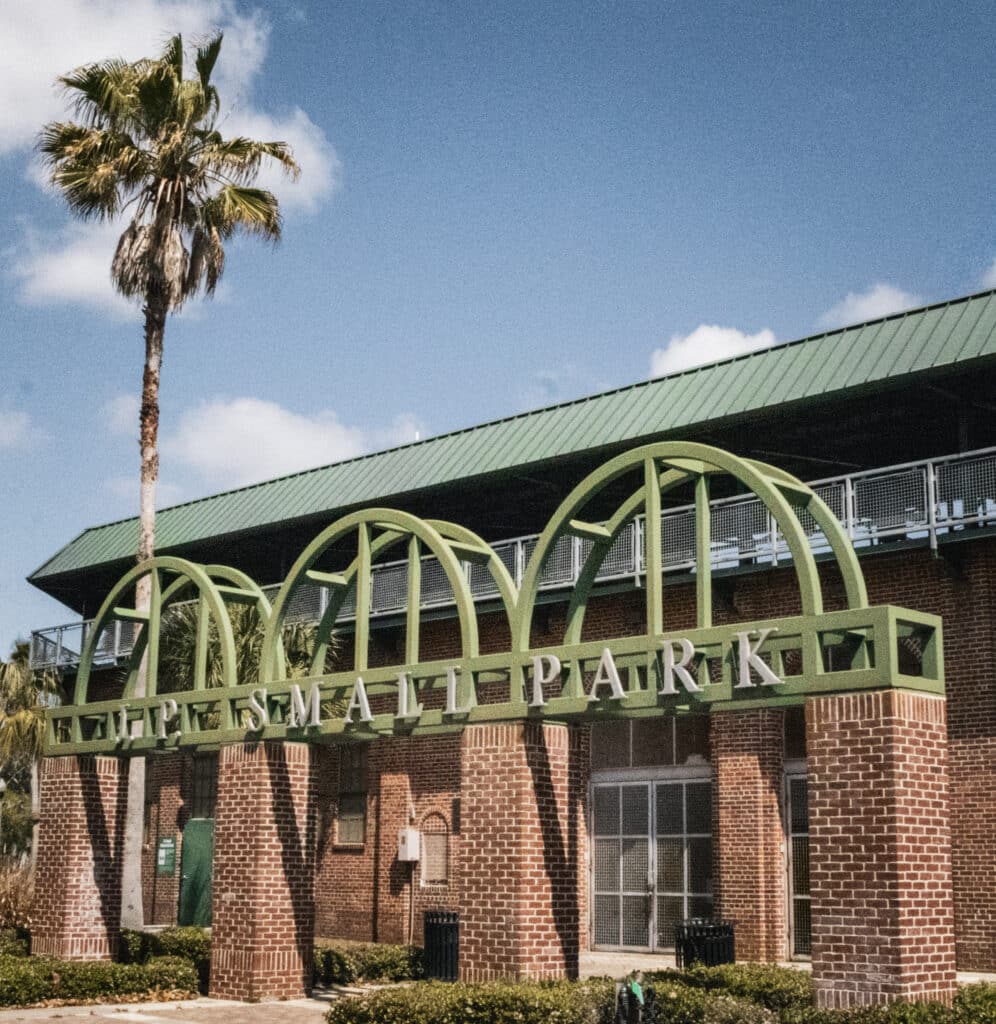
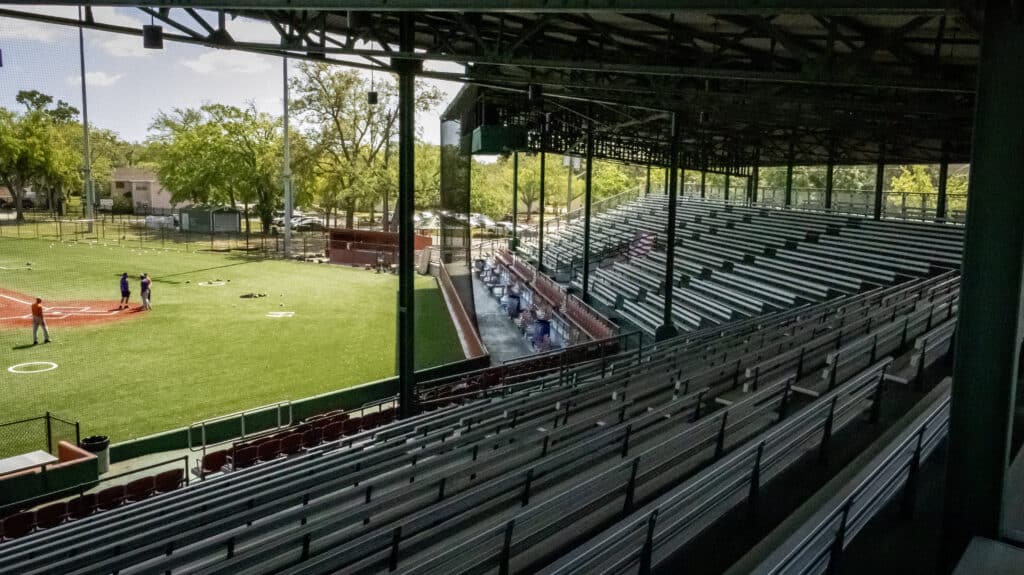
By the late 1970’s, the stadium was falling apart and was slated to be demolished. But with help of the locals, city officials approved a renovation and to rename after J.P. Small, who was a coach, athletic director, and band director at Stanton from 1934 to 1969. The ballpark is known today as the J. P. Small Memorial Stadium.
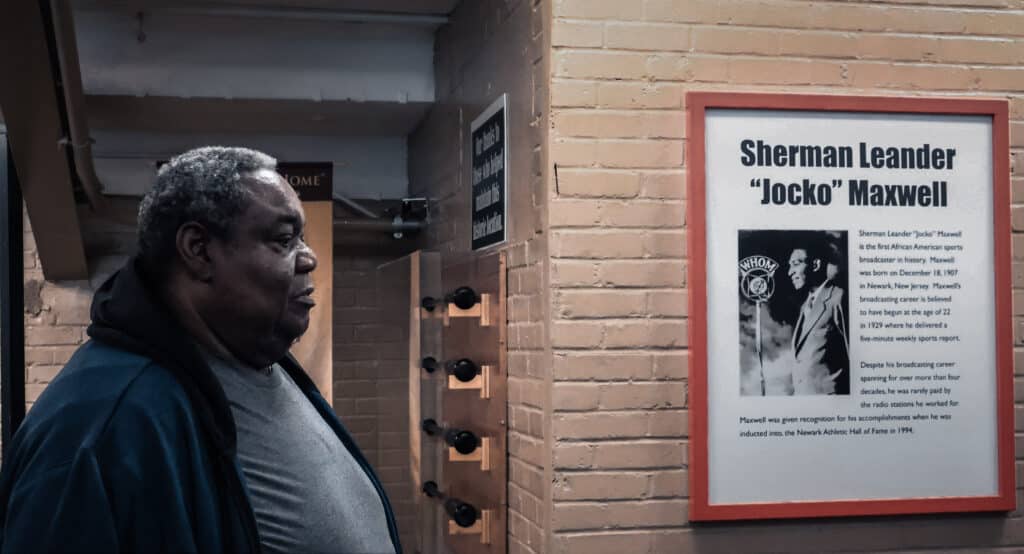
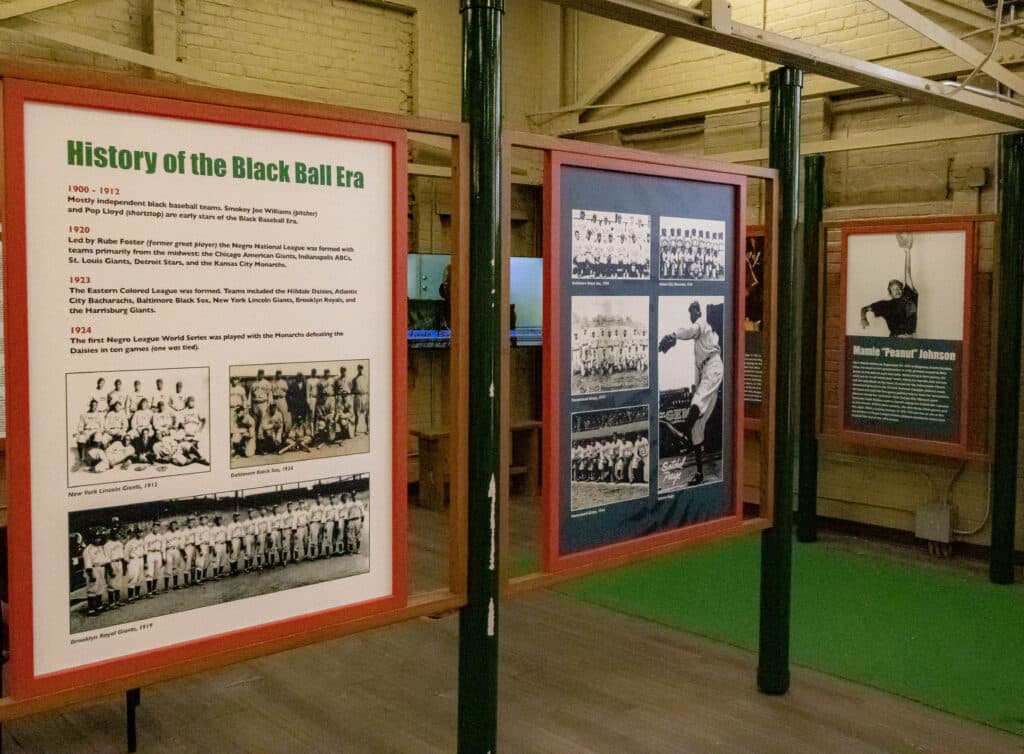
These days, baseball is still played there by Edward Waters and Stanton High. But if the bleachers could talk, it would share countless stories of what went on at the stadium. But tucked away underneath the grandstand, there is a small museum that does just that. On the outside of the stadium, there is a single door on the outside of the stadium. Next to it is a placard with the Jacksonville Red Caps logo. Behind that door is as what Mr. Lloyd Washington, the President of the Durkeeville Historical Society, calls it; “its Jacksonville Best kept Secret”. The door opens to the baseball museum, highlighting the park, the history of baseball in Jacksonville, but mostly is dedicated to the history of African American baseball leagues, including independent teams prior to the first successful organized
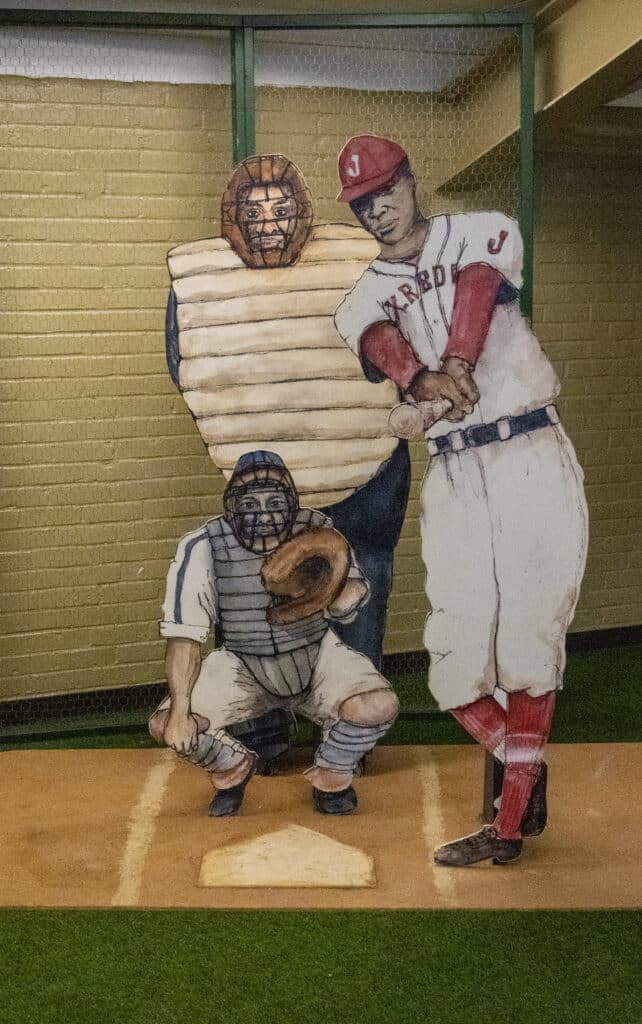
Although the museum is small in comparison to other baseball museums, it still provides a significant number of artifacts to tell the story. Original cleats from the Negro League and several autograph memorabilia from former Negro League ballplayers. Display boards detailing the history of the Negro League and its teams. Plus, additional displays featuring several prominent African American players, such as Leroy Robert “Satchel” Paige, or female players such as Toni Stone, or Mamie “Peanut” Johnson, who were two of the first women to play in an all-male league.
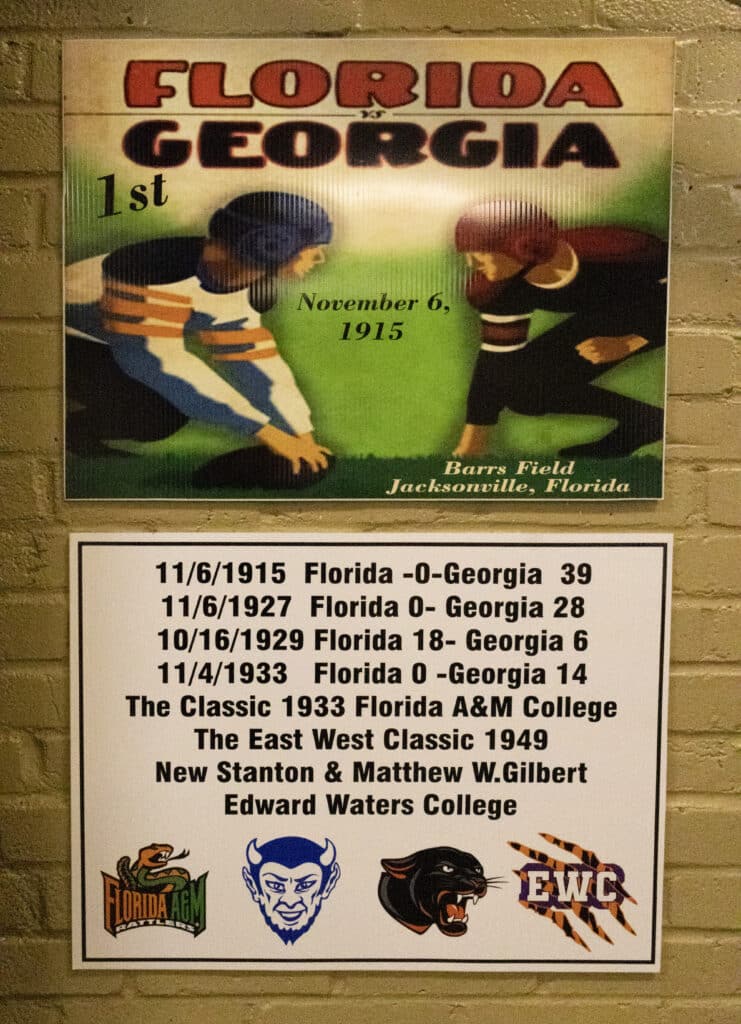
Mr. Washington did have some amazing stories to share. During an exhibition game, Babe Ruth hit a long ball that was ruled a ground rule double. The ball landed in the crowd of people standing in the outfield. Mr. Washington also shared that the Memorial Stadium wasn’t just for baseball. Some of the earlier Florida versus Georgia football games were played here. However, according to Mr. Washington, Gators fans don’t count those in the record books because the school was based out of Ocala at the time, not the current location of Gainesville. Concerts were performed here at the park, including one with Ray Charles, and some churches would hold their services here. Shared how back in the day, kids would play the hole in the wall game, one kid to watch and the other kid to watch out for the police who try to catch those trying to sneak a peek during a game.
Outside the grandstand stands a statue of a player that has been in front of the stadium since 2006. At first glance, you think it’s in honor of the individual the park is named after, J.P. Small. Or a famous player such as Satchel Paige, Josh Gibson. Mr. Washington stated that there were several arguments about who the Hall of Famer should be. Finally, the sculptor Daniel Wynn who was born and raised in the area, chose Buck O’Neil who played collegiate ball at Edward Waters University and later who played and managed the Kansas City Monarchs.
Even though professional baseball no longer plays there and the rebuilt stadium is almost a hundred years old, things look very promising for the stadium. The stadium is one of the six remaining stadiums left from the Negro League and the park was added to the U.S. National Register of Historical Places in 2013. According to Mr. Washington, Major League Baseball donated 9.5 million dollars to renovate and preserve the park. The first phase was new lighting, replacing the field with an artificial turf, which will allow for more community events. Phase 2 will bring a 2,000 square feet museum down the third base side, which will allow for additional baseball artifacts to be shown. The goal is to have the museum done by the summer of 2026.
With the assistance of City Councilman Ron Salem, who, according to Mr. Washington has been a big supporter of the stadium cause, Councilman Smith is a “fan” of the game and Director of Jacksonville Parks of Recreation Daryl Joseph, they are trying to bring MLB back or a minor league game to J. P. Small Stadium for an exhibition game. Councilman Smith, Director Joseph, Mr. Washington met with several representatives of the Jacksonville Jumbo Shrimp and together toured the park as Edward Waters were on the field for practice.
Tours of the J.P. Small baseball museum are available by making a reservation through the Durkeeville Historical Society website at https://www.durkeevillehistoricalsociety.org. The Historical Society has a separate building about a mile north of the stadium, highlighting the rich history of the Durkeeville neighborhood, which is open from Saturday 1230pm to 3pm. Additional tour time may be available with prior arrangement. The museum does host several events throughout the year, including fish fry, Jackie Robinson Day, and throwback games. Be sure to follow their website or social media accounts for more information.
- About the Author
- Latest Posts
Tobias D. Wilson, with the artist’s name of Endofthehwy media, was inspired by the literally the end of the Maine state highway 24. This was one of my favorite spots to visit while stationed at now now-closed Naval Air Station Brunswick, Maine, between 2004 to 2007.
I have been married now to a wonderful lady for 18 years and together we have one child, a nine-year-old daughter. We settled in St. Johns County after I retired from the US Navy after 20 years. My specialty in the military was administration and logistics. I am currently a stay-at-home dad and a volunteer at my local church.
In 2013, during outpatient treatment at Walter Reed Medical Center for deployment-related health issues, I was encouraged to find a hobby that I loved. I choose photography to see life through the lens.
I had the great opportunity to volunteer for two years as a still photographer for Honor Flights of Columbus, an organization dedicated to getting veterans to the memorials in Washington DC. My photos contributed to the flight mission video published on the organization’s website and YouTube channel. As a photographer, there was such joy to see the veterans return home to a hero’s welcome and be able to capture it.